Why The Wife Of A CM Was Trolled For Attending A Meeting In Her Official Home

 A recent case of trolling of the Mizoram chief minister’s wife sitting in a ‘meeting’ reflects a chronic patriarchic mindset of the society at large and the men in specific.

Women in general face everyday sexism and misogyny, be it in private or public space. But what about the women who are the wives of politicians, wives of those holding important positions in administrations or governance, and wives of ministers and heads of state?

These women are at the same time in the public and private space, and are at the receiving end of sexism and misogynistic abuse in various forms and at different levels. They often become soft targets for those against the politicians – the husband – by rivals, cynics or critics – bearing the burden of being  “the wife”.

How can the wife be there?

A glaring case of sexism and misogynist happened when last month the wife of the Mizoram CM was trolled for sitting next to her husband (at their residence) while he was in a meeting with some important officials, who were visiting guests  – US officials on a two-day visit to the state for strengthening cooperation in tourism, education and health care.

Media reports mentions that the US officials visited the CM at his residence. The picture of the said meeting at the CM residence where the ‘wife’ was seen sitting next to the CM – was mischievously posted on social media with a note questioning whether it is ‘appropriate’ for the wife of the state chief minister to be present during discussions when officials visits the chief minister.
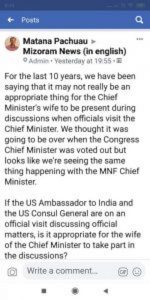
The social media post questions – “If the US Ambassador to India and the US Consul General are on an official visit discussing official matters, is it appropriate for the wife of the Chief Minister to take part in the discussions?” It also stated that this has been happening for years with the former CM as well and that it was ‘not appropriate’ for the wife to be present in official meetings/ discussion.”

Sexist reactions on the post

Obviously, the social media post generated a lot of interest- by 2 days of the post there were more than 100 reactions and comments.

Never miss real stories from India's women.

Most reactions and comments are ridiculing and abusing ‘the wife’, with insensitive sexist remarks. I happened to be one of the commenters, saying the post and the picture is misogynist.

And the immediate reaction and response to my comment goes – “what a lunatic comment” … “ She the is craziest person here”. Some tried to explain that this (the Facebook post) was not misogynist and it is a misunderstanding on my part.

Most opinions were that ‘the wife’ of a state CM should not be part of any ‘official’ meetings and discussion regarding the state of Mizoram. Or for that matter ‘wives’ of any officials or high ranking public figures should not be hanging around their ‘husbands’ during office hours or official matters most importantly ‘official meetings’ – the reason being that wives are ‘not official’ – a non-entity in public affairs.

Appropriating women’s role in society

The rightful and ‘appropriate’ place of/ for women in the society – the north-east Indian tribal society in specific –  is considered ‘behind her man’ – the father and brothers before marriage and the husband after marriage. “Man is the head of the family” is the ultimate law is not supposed to be questioned. That women are supporters – the backbone not the head. Women are not supposed to ‘peep’ and ‘interferes’ in the matters concerning a ‘man’s affairs’- office work, socio-political matters.

As for ‘the wives’ of politicians, ministers, head of states, or high ranking officials- it is even more important that ‘the wives’ must keep away from ‘public affairs’ – official matters- for they are not ‘official’.

Thus, in the above case of the Mizoram chief minister, his wife’s presence in meetings –  high profile meeting-important discussion is considered inappropriate.

What is appropriate and what is not appropriate is being discussed and decided by – obviously the men-led patriarchal society. That the accepted norm is that a woman – including wives of high ranking officials or head of states- must confine themselves to the role and responsibility of playing second fiddle to their man – the husband. That they must merely play the role of ‘arm candy’ and show up only where it is culturally and socially appropriate. That a woman’s place in the private and public – is to support the husband – not come in front but stay behind.

The question of the identity of the chief minister’s wife

Chief Minister ’s Wife – what’s her name?

The social media post did not even consider it important to mention her name. Media reports too did not find it worth a mention that the visiting US officials held a meeting with the state CM at his residence where the ‘wife’ is also present.

Her identity is ‘chief minister’s wife’ – not more than that. And that her role should be restricted and limited to being ‘the wife’- stay behind the curtain and not show your face in official meetings, not even in your own official residence where you should be the hostess. That a woman even if she be a politician’s and chief minister’s wife – is not supposed to or is expected to be interested in ‘political affairs’.

The Mizoram News Facebook page post reflects the fact that the men of the community are extremely uncomfortable with the presence of a woman in the high profile meeting. The picture – mischievously capturing the ‘wife’ looking at her mobile phone, saying that the woman in the picture is neither interested in, nor would have anything to contribute to the discussion. This also reflects the prejudiced mindset that a woman is not considered ‘intelligent’ enough to take part in the affairs of the state and official discussions!

Clearly, it’s a long way to women’s empowerment and women in decision making.


JUNE 17,2019

WOMEN's WEB 

Why “Who’s Your Husband Or Father?” Is The First Thing I’m Asked As A North-Eastern Indian Woman!

 Does a woman have her own identity? Women in the north-east of India are usually identified as “belonging to” either the father or husband, even when educated and accomplished.

For many women their identity continues to be a ‘house wife’. It seems normal and natural to say “I am a housewife”. It is so ‘normal’ and natural that when a woman introduce herself as a “housewife” it doesn’t register in one’s mind what that actually implies.

Recently I was part of the media team visiting some villages in Dimoria block in Assam. We met a lot of women both in the village and in semi urban areas. After the initial “hello” and greetings, it is usually followed by “I am a house wife’ when asked what she is doing or engages in. One really needed to probe and go slow if one wants to know what all activity she engages in. This comes only when one is interactive and pose queries about her life or daily activities – more as a conversation or a sharing and not as a question. One has to really indirectly probe to understand and know the woman – her life and all about her.

Housewife as an identity

This is not only in Dimoria or in some villages in Assam; for most women in north-east India ‘house wife’ is an identity. The concept that a woman ‘belongs’ to a man – her father – and then later her husband, has been so much internalized by women in these northeastern states that it comes naturally to them to be called ‘housewife’. They have also learnt the word ‘housewife’ – which is an English word – so that they use the right word as their introduction outside of the homes – to the outside world.

Besides internalizing and an acceptance of the given identity, it is also considered a ‘status’. One of the reasons why young girls would be constantly asked when is she getting married or taunted over marriage is that the girl / young woman needs a ‘status’ and that is of a ‘housewife’.

To be a housewife is a higher status than to remain ‘unmarried’ – that is at least to ‘belong’ to someone – a man. This also further strengthens the concept of ownership for a man – that he owns his wife – to the extent of ownership as a property or an asset. To be an asset is considered a value.

This identity is not only in rural areas. Even educated women in urban areas still introduce themselves either as ‘housewife’ or ‘the wife of so and so’. Most women who are not working outside their homes as a salaried person in an office or an institution do not considered themselves as a ‘working woman’. The new term ‘homemaker’, that is considered a better terminology than ‘housewife’ is yet to be conceptualized or understood.

The new term, however, does not make much of a difference. ‘Home making’ is an unpaid job, and not necessarily a ‘respectable one’. Given that the concept of woman at home – and making a home – is so natural that it does not make much of a difference to that of being a “housewife” – home and house is the same and the work is the same. Home – maker – signifies that a woman’s job is to “make the home’ to take care of the “home” – and not the man.

What’s in a name?

Women’s names in the north-east are also shortened, mostly a pet name. Women normally do not tell their names in full. If insisted upon, their full names would not include the surname/second name. Those that (reluctantly) spell out their full names would tell us the second name / surnames of their husband as their second name or surname.

Earlier, girls who enrolled in school would simply give their names – no first or second or a third. This has changed though over the years as there is progress in academics and school education. With an increase in enrolment, and with too many similar names – surnames have become a necessity.

Interestingly even academically educated and accomplished women, after their marriage changed their second / surnames and take their husband’s names. This is done legally and their affidavits can be seen published in newspapers.

In north-east India it is considered that a woman does not have a ‘permanent’ surname / second name – here the clan name is the second/surname name. A woman, when married, left her ‘clan’ and became – actually adopts – her new clan – that is her husband’s. Thus she is required to use the clan name as her own second name.

Ownership – a man owning a woman

A woman before marriage is under the ownership of her father or in his absence her brother or clan / a male family member. This ownership is sort of like – owning a property / asset- where claims are made by the owner.

This is obvious when statements such as this are made to a woman – whom do you belong to? After marriage she is considered ‘belonging’ to her husband and his clan. Thus a man is the owner, and a woman belongs to her father before and later to her husband – not only the individual but the whole family clan.

Identity

A woman’s identity therefore is ‘fluid’.

Her identity as a daughter, a sister change to that of a housewife, a mother. In any profiling of a woman, be it in more advance or lesser privilege – a woman is often described as a – mother of n number of children, or wife of so and so. While the profile of man usually not have any of such mentions – like “he is a father of n number of children”. If a man’s profile mentioned his wife or number of children, the better half or wife would obviously be a well-known personality (with an addition of a mention of her father!)

A man behind every woman?

When I started writing and my name in the byline began frequently appearing in the media, people started asking “who is your father?”. Even more annoying is the frequent question “are you the daughter of x ( one high profile relative)”.

The obvious assumption is that a there should be someone – of course a man – the father – behind a woman. Your identity comes with a tag or a label, an addition. Or does a woman even have an identity of her own?


APRIL 7, 2019

WOMEN'S WEB